Should I ship?
When the truck can’t turn back, recommend on the worst case. A tool that knows when to stay silent is what earns a seller’s trust.
- Who
- An onion trader or farmer-seller in Gujarat with stock to move. Thinks in aaj ka bhav, today’s going rate, not in statistics.
- Trying to do
- Sell where the load nets the most: here today, or a mandi 200 to 340 km away.
- Where it breaks
- The moment the truck rolls. They’re committed to whatever the price is two or three days later, minus transport.
- Why the business cares
- One load sold below the local price they walked away from, and the seller is back to rumour and WhatsApp.
What I saw
I built one daily “going rate” per market from the government’s own mandi price data: volume-weighted across onion varieties, because that’s the number a seller actually experiences.
AhmedabadSuratRajkot14 Aug 2026 · ₹854 between highest and lowest
Then the question that decides the product: can anyone forecast the price across the two or three days a truck is on the road? I set a deliberately dumb forecast, “the price stays where it is”, against Prophet, a proper time-series model. Both predicted three days ahead, on days they had never seen.
Three-day-ahead forecast error (MAPE), lower is better
Surat calm
Ahmedabad calm
Rajkot volatile
The dumb forecast won both calm markets, by a mile. Prophet only won in Rajkot, where prices swing so much that “stays the same” goes stale fast. Doubling the data cut Prophet’s error in Surat by about 40%. It still lost.
What I’d try first
B. The decision is irreversible, so a wrong “Ship” costs far more than a missed one. Pick the model per market by volatility, forecast only across the transit window, and give one of four answers: Ship, Stay local, Risky (your call), or Too volatile to call. A price rise in transit is upside; a drop is already absorbed.
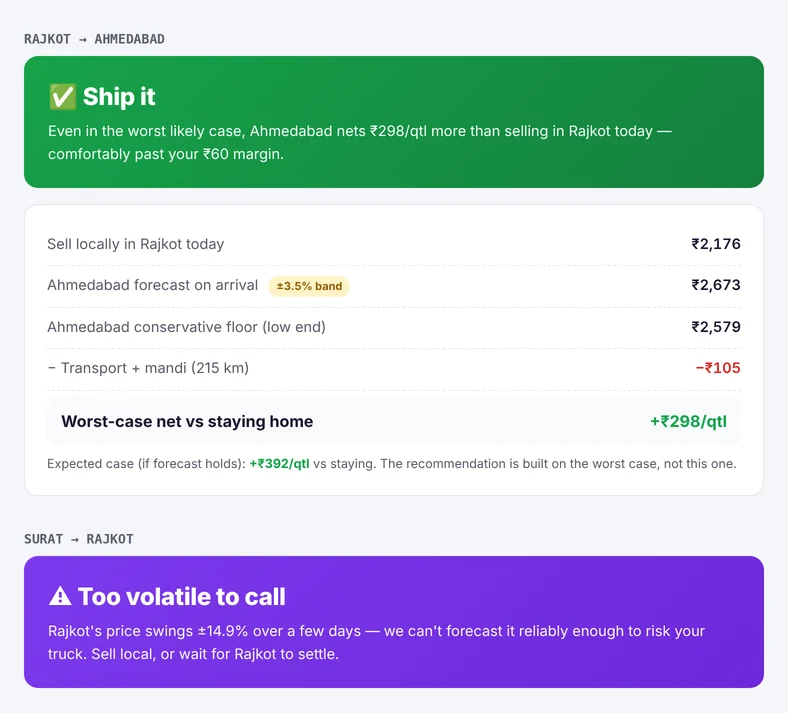
How I’d know it worked
| Goal | Signal | Metric |
|---|---|---|
| A better routing call than gut, on the calls sellers actually follow | Sellers act on “Ship” (30% in month one) and come back (25% at week four) | Realized ₹ per quintal on followed Ship calls, against selling local |
| Guardrail | Bad-call rate: followed Ship calls that did worse than selling local stay under 15%. And “Too volatile” fires on more than 80% of genuinely volatile days. | |
What I’m not sure about
- I designed for the trader from reasoning, not from talking to one. That’s where I’d start.
- The live price source only goes back to November 2025 and blocks scraping. A reliable daily feed is the dependency everything else sits on.
- Where the seller’s real numbers come from: the local price they’re actually offered, and their real freight rate.
- Seasonality needs two years of data. At 19 months it made the longer forecasts worse, so it stays off.
Keep reading
- The prompt is a document too — AI UX
- “Why do you need all this?” — Fintech UX
In my work: Crypto derivatives: the product audit. About Uday Dave · Explore the portfolio.