Live prototypeJewellery retail · Independent · 2026
Build it for the jeweller the family already trusts
Why would a family buy bridal gold from an app?
- Role
- Product, design and direction
- Context
- Self-initiated, on my own time
- Dates
- September to October 2026
- Time
- 6 min read

The decision in 20 seconds
Situation
Families buy bridal gold rarely, in person, from a jeweller they trust.
What happened
Live on a TV in four languages. No showroom pilot yet.
Context
The product, the people, my role.
Bridal jewellery in India is a family decision made in a shop. Half of the country’s gold jewellery demand is bridal. The bride tries pieces under shop lights, her mother is at home, and her father wants the number. Someone sends three blurry phone photos and a price typed into WhatsApp, and the decision waits for a second visit. Sometimes it goes to the shop down the road.
Aarsi is my own product, built on my own time. It started as an app for the bride’s phone: try pieces on, show the family, decide together.
The problem
What was going wrong, and the evidence.
The phone version had a dead zone at its centre. Families buy gold once in years, and they buy it from the jeweller they trust. I do the same. Online was only 3–5% of India’s jewellery sales, and independent jewellers held about two-thirds of retail (World Gold Council, 2022).
An app that sells to the bride directly has to pull her away from that jeweller, and that is the one relationship families don’t leave.
The app was asking families to leave the one shop they trust.
What I found
What I saw, kept apart from what I assumed.
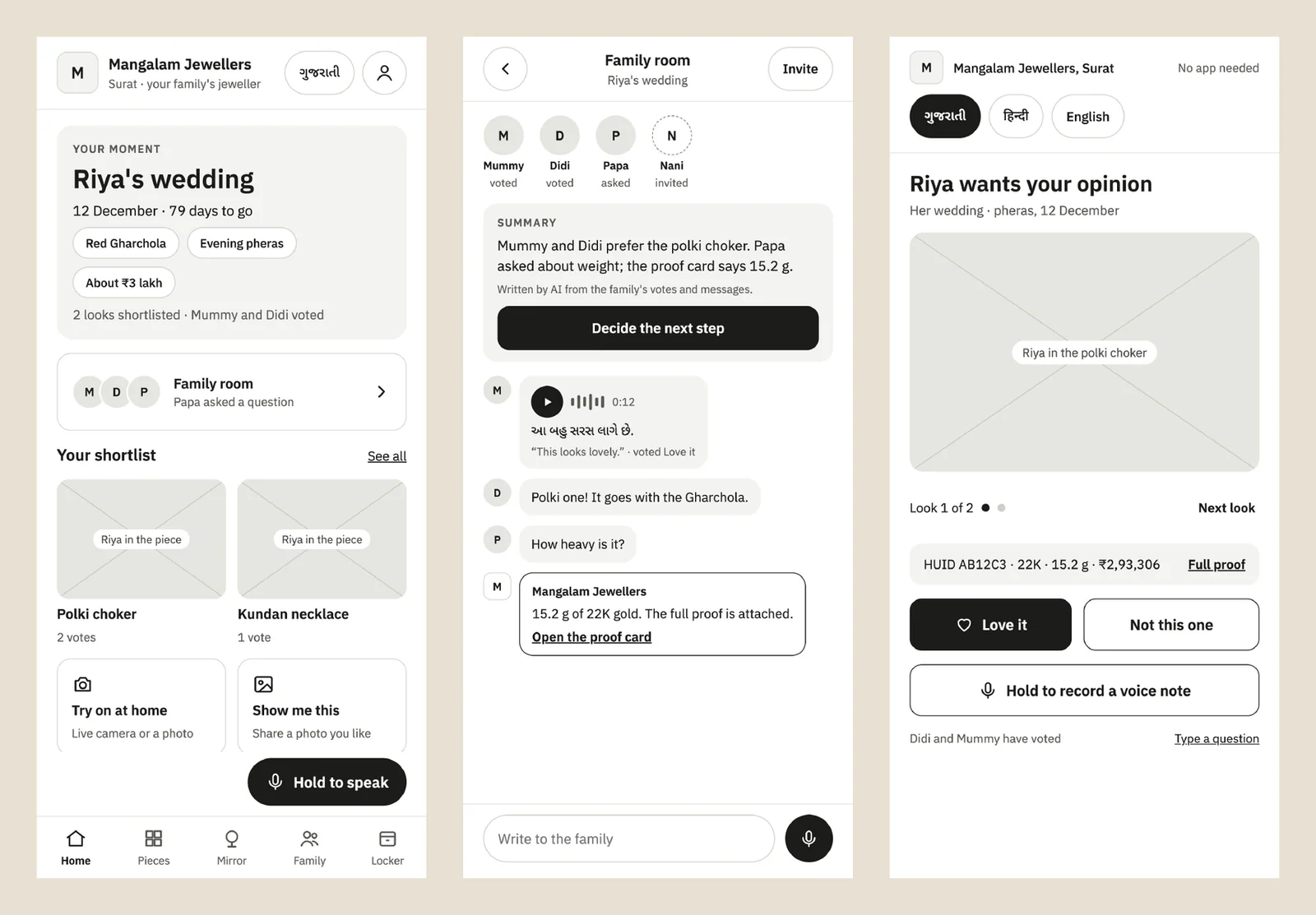
Every try-on in India sells the same thing: see it on you. Nobody I could find sold what the family actually needs, which is to decide it together, with a price they can trust. The price breakup looks different at every jeweller, and the family at home sees none of it.
Smaller jewellers still sell from printed catalogues and photos on a phone. When nothing in stock pleases, the customer shows a photo and a custom order starts there. Kiosk mirrors are listed at ₹2.3–7.5 lakh, and most showrooms already have a TV on the wall.
So I drew both sides before any code: the family’s phone, and the jeweller’s screen.
The decision
The options, and why this one.
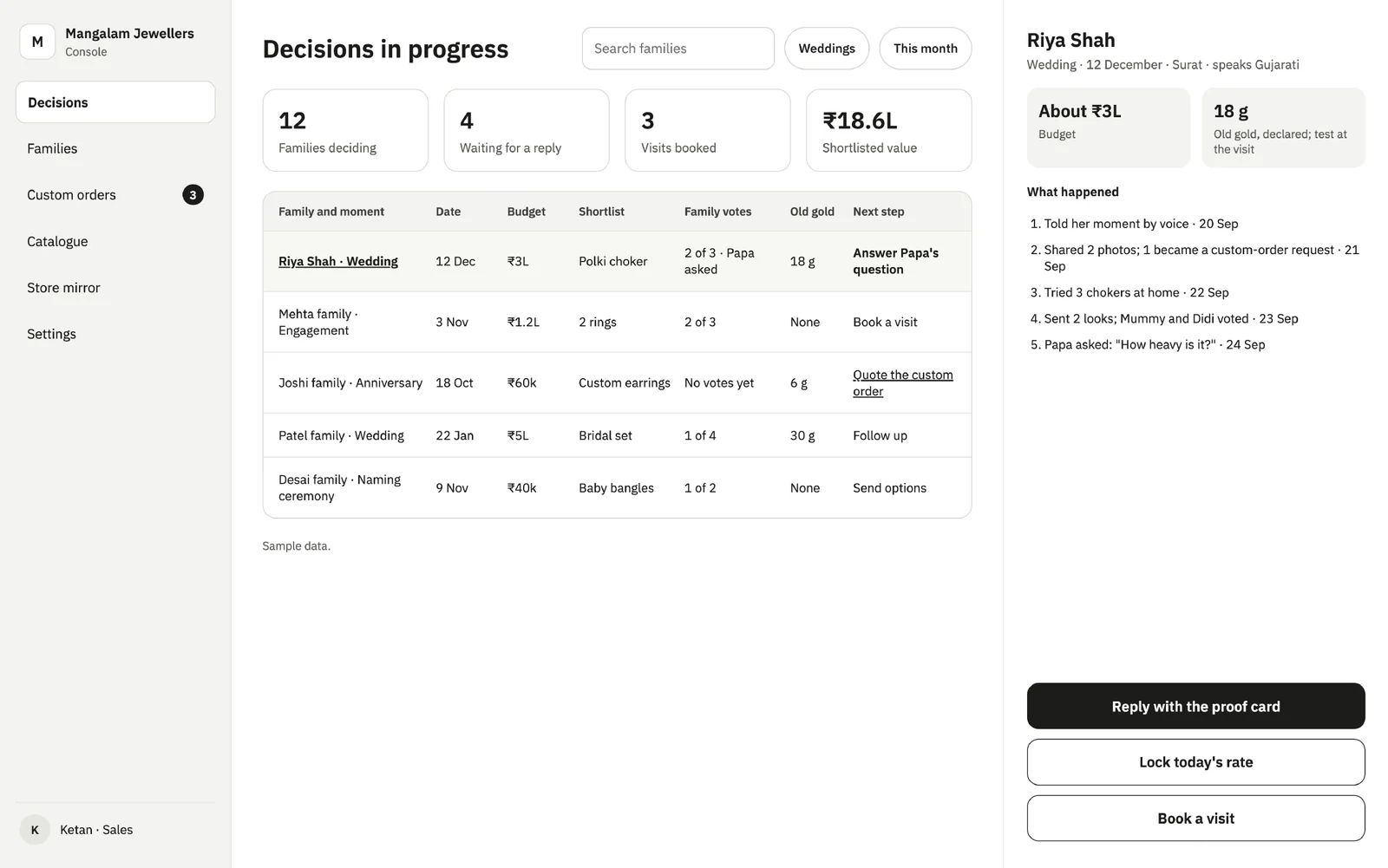
I flipped it. The jeweller brings the families and pays, the family decides together, and the sale still happens across his counter. Try-on stays, but only as one input. Other mirrors answer “how does it look?” This one answers “should we buy it?”
Don’t fight the trusted jeweller. Make the product his.
That call set every rule that followed. The showroom’s own TV becomes the mirror, so there’s no kiosk to buy. Weight, purity, HUID and today’s rate come from the jeweller’s records, and the AI never touches a price. The jeweller sees each family’s decision in progress, not a page of try-on analytics.
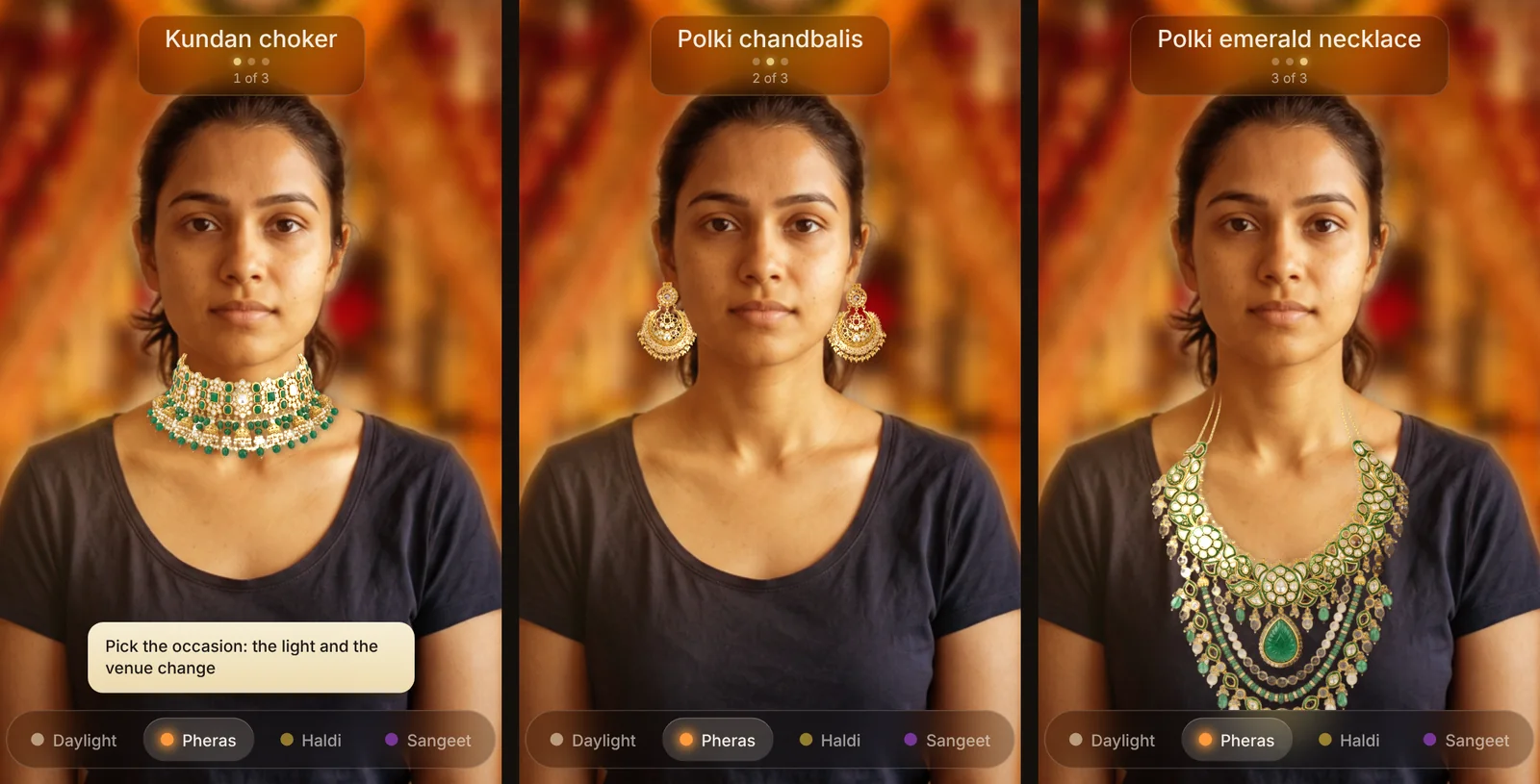
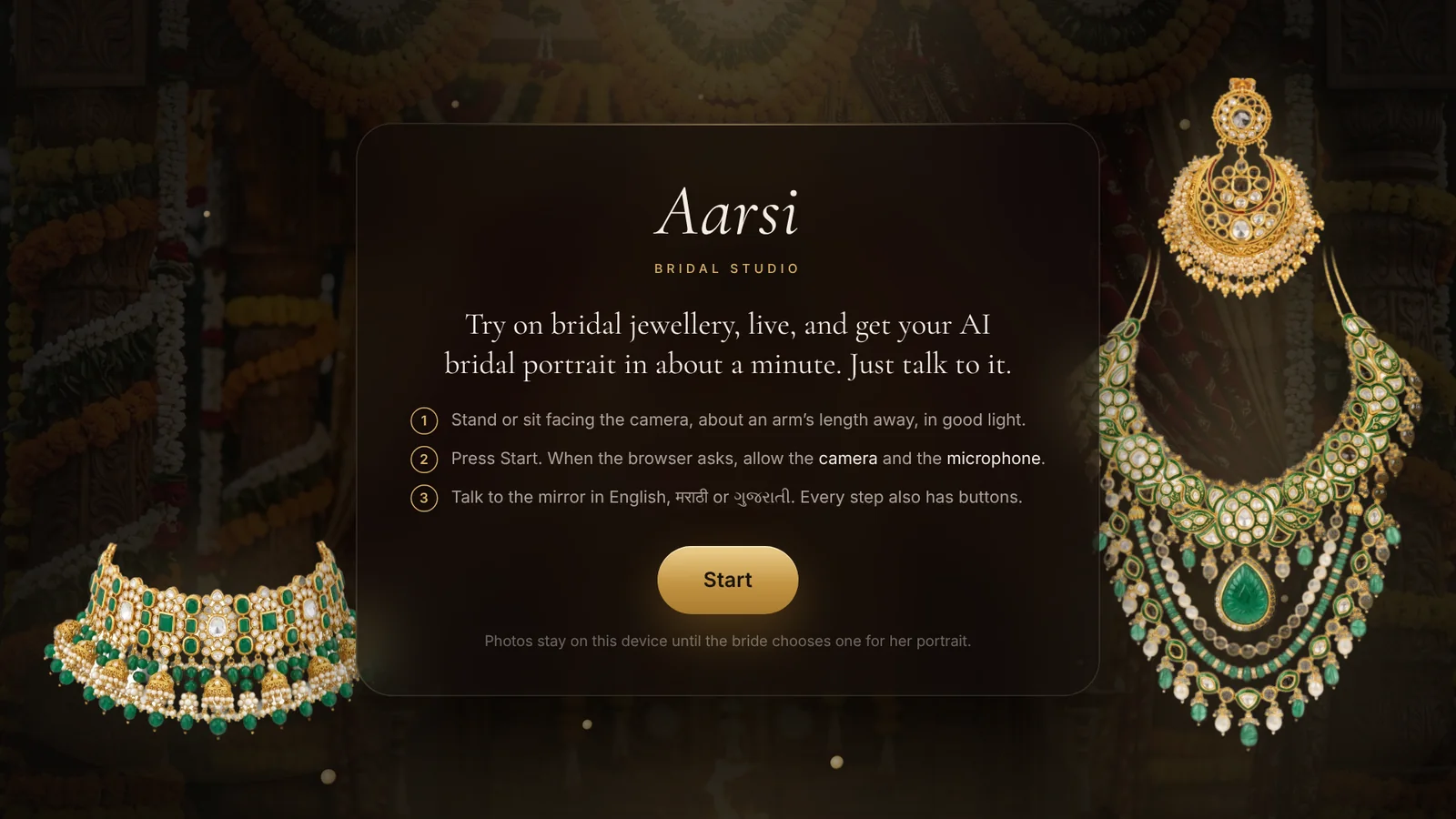
Then I built the showroom moment for real. The bride stands in front of the TV, and her collection plays on her live, one piece at a time. It talks with her in English, Marathi, Gujarati, or the Marathi–English mix people actually speak. Every action also works by hand or button, because a showroom is noisy.
The trade-off
What I gave up, and why it was worth it.
I gave up the audience to get the buyer.
The phone app had reach. It was free, and every look sent on WhatsApp pulled more families in. Jeweller-first grows one showroom at a time, through sales conversations, and it only exists where a jeweller switches it on.
The demo is narrow on purpose too: three pieces, flat cut-outs instead of 3D models, and an AI portrait that takes about 25 seconds and is labelled as a styling preview. I spent the time on the moment the family decides, not on catalogue breadth.
What happened
The honest result: shipped, changed or stopped.
Live
The studio on a TV, in four languages, in about a week
Tested
On a home TV with family: the flow ran end to end
Not yet
No jeweller has run it in a showroom
The first real run found what desk testing never would. The AI portrait changed the bride’s face whenever her photo was taken from across the room. I moved the photo capture to when her face fills the frame and sent the model a close-up, and the faces held.
A 30-day pilot with one or two showrooms is written up and not started. It answers one question: does the family decide in one visit instead of two? Until then there’s no conversion figure to claim.
What I’d do differently
One lesson about the design, not the paperwork.
Design the mirror on the mirror.
Two rounds of polished screens were designed on stock photos, and I threw both away. A mirror is judged by a real face, moving, in showroom light, at TV distance. None of that exists in a mock-up. The interface only got good once it was designed on the live camera, on the TV.
Facts
For the reader who skims to the end.
- Role
- Solo. The bet, the jeweller-first pivot, the flows, the wireframes, the design direction, and every test on the TV.
- Method
- Code written with an AI coding agent, day by day against my plan and my test gates. I reviewed each build on the TV and decided what changed.
- Stack
- Next.js in the browser, MediaPipe face and hand tracking, Gemini for the portrait, Supabase for looks and votes, Netlify.
- Cost to run
- About ₹10 per AI portrait. The live try-on is free, because it runs on the showroom’s laptop.
- Note
- The jeweller (Mangalam, Surat) and the customer are invented. The customer and all three pieces are AI-generated. No real person’s photo is shown.